Saturday, 10 January 2015

Social design


Post-war British design propaganda: Richard Guyatt (1914-2007), cover for
Alan Jarvis, The things we see: indoors and out (Harmondsworth: Penguin, 1947)
Forming an organisation dedicated to the promotion of an idea, a cause or an interest, is one of the hallmarks of modern society. In one sense, these modern social bodies have, in our most recent history, shaped the way we perceive and understand how we order the world by creating a concept of human, educational, cultural and intellectual capital in lieu of one based almost entirely upon the control of land. Ranging from learned bodies such as the Royal Society of London (1660) to ‘professional’ bodies such as the Institute of Chartered Accountants in England and Wales (1880) and, closer to home, the Designers’ Institute of New Zealand (1991) they are, in effect, one of the more tenuous manifestations of service capitalism.

In a 2012 lecture to the Friends of the Hocken Collections – another sort of social body – the photographer Gary Blackman referred to the Dunedin-based Visual Arts Association, an organisation established in 1951 ‘to encourage the appreciation of good design’, that he had chaired for a time (G Blackman, Aspiring to art; the William Mathew Hodgkins memorial lecture (Dunedin: Friends of the Hocken Collections, 2014), p. 26). The association's formation is telling evidence of the collective way many New Zealanders came to appreciate and understand design, a process that had been either marginalised or ignored in New Zealand's short history of Pākehā culture. Like much else in post-war New Zealand, the design debate was predominantly a British cultural import and it arrived in New Zealand through a variety of media including journals, books, lectures, newsreels and, not least, designed commodities.

The Visual Arts Association was not the the first locally organised body established in the face of national indifference to design matters. The earliest – and the sole survivor of the phenomenon – was the Wellington-domiciled Architectural Centre. Formed in 1946 with the utilitarian purpose of providing a support framework for Wellington-based students of the Auckland School of Architecture, the centre, almost incidentally, expanded its remit to promote and encourage a debate about how larger issues of design could be encouraged to flourish in a local context. Between 1948 and 1952 it sponsored the publication of Design Review, the first journal in the country to explore the concept of design in a critical fashion. With its focus on regional modernism and embrace of theory, the centre espoused a progressive ideology; a number of its key figures – Ernst Plischke springs to mind – were refugees from Nazism and they understood that design was political.
New Zealand Design Review, vol 1, no 1 (April 1948)., p 1
New Zealand Electronic Text Collection/Te Puhikōtuhi o Aotearoa
In Auckland, such concerns were regarded with a degree of distrust. In 1949, in the wake of a visit by the British industrial designer Milner Gray, a group of interested individuals with an interest in design issues associated with Cyril Knight (1891-1972), professor of architecture at the Auckland University College School of Architecture, formed the Auckland Design Guild, ‘an association providing for the exchange of ideas on the arts and sciences connected with design’ (‘Pledge to combat shoddiness’, New Zealand Free Lance (27 July 1949), p. 9). Knight, an Australian who had been appointed to the school in 1924, had conservative rather than modernist inclinations, a tendency reflected in the archaic designation of the body as a ‘guild’. The guild’s existence was fleeting; it failed to survive the year. One former, architectural, member later recalled it as ‘too theoretical’, explaining that ‘considerable time was devoted to ruling out any commercial exhibition of members’ work’ (P Parsons, ‘The postwar development of industrial design in New Zealand’, New Zealand Manufacturer, 18:1 (October 1965), p. 68). In fact, a surfeit of theory was probably the least cause of the guild's failure. It was more probable that, like many of his academic contemporaries in Britain, that Knight - no theoretician – objected to the guild being used to provide commercial enterprise with a veneer of objective respectability; it was too difficult to reconcile arts and crafts romanticism with the pragmatics of growing a business.
Unidentified photographer, 'Modern room setting at Dunedin Public Library, 1953'.
From G Blackman,  Aspiring to art: the William Mathew Hodgkins memorial lecture 2012
(Dunedin: Friends of the Hocken Collections, 2012)
The Visual Arts Association was formed as a consequence of two meetings convened by the Adult Education Department of the University of Otago and its first chair was Dr Edward Murphy, lecturer in design at the School of Home Science. Its first pamphlet declared aspirationally that ‘the terms of reference of the Visual Arts Association are very similar to those of the Council of Industrial Design (CoID) of Great Britain, even though the association is a voluntary body’. However, where the CoID was charged by Parliament ‘to promote by all practical means the improvement of design in the products of British industry’, the Dunedin association was restricted to embellishing the Lecture Hall of the Dunedin Public Library with, as Newman recalls, ‘a room setting furnished with a range of [imported] objects selected from local shops’.  The furniture, though, was New Zealand made although, looking at the photographic evidence, much of it it was based on designs pirated from Australian and United Kingdom prototypes (T Esplin, ‘Visual Arts Society’, The Press (15 May 1962), Supplement on design in industry, p. 4). As Blackman relates, the association's ambitions were not matched by the reality of it being a small, university-based, organisation and it 'soon broadened its concerns to include current visual arts and crafts and undertook a wide-ranging programme of lectures, panel discussions exhibitions and films. The association was wound up in 1968. 
Unidentified photographer, 'Exterior of the Design Centre, Haymarket, [London], 1958'.
Probably the most ambitious of the mid-twentieth century New Zealand design promotion bodies was the Christchurch-based Design Association of New Zealand (DANZ). In July 1957 Roger Lascelles (1928-), a self-described Christchurch ‘foreign and intercolonial buying agent’ – recently returned from Britain and impressed by the CoID's recently opened London 'shop front', the Design Centre – had a letter published in Design, the house magazine of the CoID:
By December 1959, Lascelles – who was well-connected in Christchurch social circles – had begun organising for the creation of a similar facility in New Zealand, albeit on a smaller ­scale. Alerted to these moves and responding to enquiries received from the CoID concerning Lascelles’ status, the Department of Industries and Commerce (DoIC) interviewed him, reporting that:
Mr Lascelles is very keen about the subject of industrial design and appears to be well informed. He is full of enthusiasm and could, I think, do some useful work in making the subject more generally known in New Zealand, provided his group consists of responsible and more mature people who could guide him; perhaps they might even have to restrain him (Archives New Zealand IC W1926 57/1/6 vol 1 box 1797, Memorandum from H Larsen to W Sutch, 25 January 1960). 
Seemingly unaware that the DoIC had been investigating the idea of a local design council since the election of the second Labour administration in 1957, Lascelles, as ‘honorary secretary pro tem’ of the association began soliciting national interest in the setting up ‘a Design Organisation similar to, but on a more modest scale than the Council of Industrial Design in London’. The association claimed twenty 'founders': seven architects (including Peter Beaven, Miles Warren and Paul Pascoe); four 'designers' (including John Simpson, a British craft silversmith); three solicitors; two engineers and one printer (Leo Bensemann), an importer (Lascelles) and a journalist. By June 1960, although Lascelles had subsequently returned to London, a small committee under the guidance of Simpson, who was professor of fine art at the University of Canterbury, had developed the text for a pamphlet explaining the aspirational aims and ambitions of the society.
Title page of the prospectus for the Design Association of New Zealand (1960)
National Library of New Zealand/Te Puna Mātauranga o Aotearoa
The association’s main object, it asserted, was ‘the encouragement of Good Design in every sphere of life’, positing that ‘Good Design is a matter of national importance and that it is imperative for New Zealand to have, now, its own properly constituted Design Association supported by public funds though independent of government direction’ (Archives New Zealand IC W1926 57/1/6 vol 1 box 1797, Letter from A Hearn to W Sutch, 24 June 1960). There was an undoubted spirit of enterprise driving the members of the association and by the end of 1961 they had contacted a number of like-minded individuals and organisations throughout the country and were in the throes of organising one of the earlier design exhibitions to be held in the country. Opening on 15 May 1962 and displayed in the less than salubrious Canterbury Society of Arts premises in Durham Street, Christchurch, the exhibition was launched with a speech from the associate minister of trade and industry and accompanied by a gracious address from the governor general who was not present (both texts were drafted by the DoIC). While no catalogue was produced, the Press printed a six page supplement, paid for by advertisers: the PDL Industries Ltd advertisement occupied the entirety of page one (‘The Press supplement on design in industry’, Press (15 May 1962). The exhibition attracted 8,700 visitors, a number that exceeded even the Association's best hopes, but it was a unique event and by 1965 it seems to have effectively dissolved, albeit after some of its office holders had led rancorous attacks on the DoIC in respect of its proposals to establish a design promotion body in New Zealand.
How to press the buttons of the electorate: 'A greater range and variety in consumer goods' and 'Board of Trade to advise on imports and industrial matters'.
Consumerism at the heart of National party 'non-design' advertising for the 1949 general election in the Otago Daily Times.
New Zealand Election Ads
The DANZ's vision of a private organisation undertaking similar design promotional activities as the CoID, funded by the taxpayer but ‘independent of government direction’, was a somewhat ingenuous reading of the situation, one that misunderstood not only the nature and function of the ostensible prototype and its relationship with government but also the changing economic order as Britain shifted its trade from its former empire to Europe. It’s tempting to think that the primarily aesthetic understanding of design espoused by the DANZ was more a consequence of residual Anglophilia in establishment Christchurch – a concern with the awfulness of popular taste was one of the hallmarks of the British modernist debate – but there seems to have been something more to the argument. Since its introduction in 1938, the import licensing regime adopted by the 1935-49 Labour administration had been subjected to prolonged attack from not only the opposition National party but also from retailers and architects who argued that it denied consumers access to well-designed British commodities. In fact the problem of restrictions on choice lay more with the cosy arrangements entered into between British manufacturers and those responsible for selecting what was imported into New Zealand under the licensing regime as well as with New Zealand's membership of the Sterling Area. Lascelles’ occupation as an indent agent - albeit one working primarily with sports equipment - and the argumentative 'government interference' tone adopted by the DANZ, which would become increasingly evident, suggests that one of the association's more tacit purposes was ideological. Moreover, its understanding of design seems to have been inclined toward the superficial with a focus on aesthetics and 'taste', rather than seeing it as a process encompassing production, mediation and consumption.
Unidentified designer, poster for a series of lectures by Colin Barrie, director of the Industrial Design Council of Australia (1962).
Archives New Zealand/Te Rua Mahara o te Kāwanatanga, Wellington (IC W1926 Box 67 57/1/6 pt 2)
Lascelles wasn't the only individual to contact the CoID 'expressing enthusiasm for its aims and interest in establishing something similar in New Zealand.' (Archives New Zealand IC W1926 57/1/6 vol 1 box 1797, Letter from M Browne to W Sutch, 11 January 1960). Jolyon Saunders, a newly appointed lecturer in design at the Elam School of Fine Arts – which had come under the control of the Auckland University College in 1950 – had also been in touch with the CoID in his capacity as secretary of a new design group, the New Zealand Society of Industrial Designers (NZSID), being set up in Auckland. A colleague of Saunders at Elam, Robert Ellis, in his capacity as chair of the new society, had also contacted the DoIC indicating that the new body was in the process of obtaining legal status (Archives New Zealand IC W1926 57/1/6 vol 1 box 1797, Letter from R Ellis to W Sutch, 23 November 1959). The NZSID differed from the other design societies in being intended as a 'professional institute safeguarding design, designers and the public and compiling registers, etc.' Notwithstanding these ambitions, the new society foundered, only to be revived two years later when the British arts educator Paul Beadle (1917-1992) was appointed head of Elam in 1961 and, on his arrival in 1962, elected as the re-titled president of the hitherto quiescent NZSID. Prior to taking up his appointment in Auckland, Beadle had been head of art schools in Newcastle (NSW) and Adelaide (SA) in Australia and appears to have had dealings with the Industrial Design Council of Australia. In Auckland, Beadle - who had been admitted to membership of the British Society of Industrial Artists in 1947 – placed the revived NZSID – which had around twenty members – onto a war footing with a programme of lectures, an exhibition, 'Designed in New Zealand' (May 1963), talks with manufacturers including the New Zealand Manufacturers' Federation, and consumer organisations such as the Auckland District Consumer Committee. He also approached DANZ seeking not only financial support for his agenda of professionalising the practice of design but also backing for a forthcoming battle: Beadle had identified the DoIC generally and its permanent secretary Dr W B Sutch specifically as the enemy.
Rod Harvey, Setting designed by John Crichton for the NZSID's May 1963 exhibition 'Designed in New Zealand'.
From Home and Building (June 1963)
It's unclear what activated Beadle's animus, but it was uncharacteristic; Reynold Macpherson describes him as a 'gentle liberal humanist'. As has been observed previously on this blog, as early as 1958 the DoIC had formed a study team to investigate the workings of design councils around the world, with a focus on those that had been established in Britain, Australia, Canada and Denmark. Although the National party won the 1960 election and its ministers of trade and industry despised Sutch and sought his removal, they also sanctioned the DoIC's design council proposals to the point that subsequently they claimed credit for its invention. All this notwithstanding, in September 1963, in an effort to avoid departmental scrutiny of the exchange, the executive committee of the NZSID instructed Saunders, still its honorary secretary, to write privately to the parliamentary undersecretary for industries and commerce on behalf of 'the the only professional organisation of practicing designers in this country'. Saunders reiterated the society's vehement objections to 'a proposal to establish a Council of Industrial Design under direct departmental control'. Although there had been in fact no such proposal from the DoIC, Saunders asserted that while the society, along with the DANZ, supported the establishment of a design council, it must be 'autonomous', alleging, without supporting proof, that 'An autonomous Industrial Design Council was established in Australia recently on a very small budget, and has had a tremendous impact on Australian industry'. He then asserted a series of mistruths that 'no informed design organisation in the country supports the existing proposals for a Council of Industrial Design and the manufacturers themselves want nothing to do with them in their present form' (Archives New Zealand IC W1926 57/1/6 vol 3, Letter from J Saunders to L Adams-Schneider, 13 September 1963). Notwithstanding the heated rhetoric, support for the NZSID's position was far from the unanimity it claimed, even within the DANZ; its then president, Paul Pascoe, for example, seems to have considerable misgivings about the association's backing of the NZSID and contacted Sutch expressing his support for the DoIC proposals.

In fact both the NZSID and elements of the DANZ appear to have been confused as to the function of a design promotion body - such as the CoID or the IDCA, both of which had been developed within the appropriate ministries of trade: they were not formed to impose state regulation on design or designers or to determine an approved standard or type of design. In a briefing note to the minister, Sutch opined:
The successful operation of a design council would lead to a developing understanding of good design, but basically the objectives of establishing a design council are to ensure ways by which the best design practices may be encouraged in industry, and educational facilities improved as necessary, to provide industry with adequate numbers of suitably trained designers. In other words, the main justification for the work of a design council is economic, leading to a better use of the country's resources, a decreasing pressure for imported manufactured goods, and greater opportunities for export trade in such products 
As Sutch observed to the minister, design councils were not just about aesthetics. (Archives New Zealand IC W1926 57/1/6 vol 3, Memorandum from W Sutch to Minister of Industries and Commerce, 20 September 1963). As it was, Saunder's letter was the last shot in Beadle's war. In March 1964 Sutch briefed the parliamentary undersecretary for trade and industry noting that the DoIC had been in contact with 'Professor Beadle of Auckland who on various occasions expressed publicly his strong disagreement  with the [proposed council]. He has since privately told the department that he will not obstruct the establishment of the Institute (sic). Both Beadle and Saunders resigned from the executive of the NZSID, being replaced by Keith Mosheim and D J Haynes respectively, both practitioners working in the private sector. Mosheim wrote to the minister requesting that it should be represented on the proposed council but when the council was, finally, brought into being in 1968 no members of either the NZSID or the DANZ were appointed. The NZSID survived as a practitioner body until 1988 when its members voted on a change of constitution and name. In 1991 the re-jigged organisation merged with the New Zealand Association of Interior Designers, emerging as the Designers Institute of New Zealand.

New Zealand first became a part of the world economic system at some point near the end of the eighteenth century. Like most colonial constructs, it exported products that would be transformed elsewhere, usually in Britain and, employing Keith Sinclair's memorable expression, 'imported its standards of living'. Peter Gibbons, noting the endurance of this long-standing colonial relationship, has elaborated that 'Even when local production of goods has been promoted and encouraged, at times subsidized, such goods, based upon designs and technologies developed elsewhere in the world system, are seen as substitutes for the 'real thing'. [...] People want goods from elsewhere, preferably with designer labels, not what is homegrown' (P Gibbons, 'The far side of the search for identity: reconsidering New Zealand history', New Zealand Journal of History, 37:1 (2003), 38-47, p. 42). The post war design societies were a collective response in an attempt to deal with what can, in retrospect, be identified as a cultural concept imported from Britain. The way that the societies processed this newly translated notion of design varied: by adapting it to the local condition, as the Architectural Centre was to do; by ignoring it, as the short-lived Auckland Design Guild did; by using it to define a newly 'professionalised' occupation as the NZSID sought to do; or as the DANZ aspired to do, by using it in an attempt to reinforce a colonial status quo.


Thursday, 25 December 2014

Designs on flags

The New Zealand ensign. Although this image is what is currently provided by the responsible ministry, the flag colours are, more correctly, red (Pantone 186C, websafe RGB 204-0-0), blue (Pantone 280C, websafe RGB 0-0-102) and white.
Manatū Taonga/Ministry for Culture and Heritage
In March 2014, in a move presumably designed to divert public attention from more pressing issues of politics such as the state of the economy or the ethical performance of his administration, John Key, the New Zealand prime minister, announced that should his conservative National party win the forthcoming general election, a referendum would be held on changing the country's flag. In a set piece speech Key declared: 'It's my belief, and I think one increasingly shared by many New Zealanders, that the design of the New Zealand flag symbolises a colonial and post-colonial era whose time has passed'. Key's move found some editorial support amongst the media, with the conservative New Zealand Herald opining that it didn't go far enough, but there seems to be little popular support for a change, particularly among the elderly and those adhering to the traditional right. The National party went on to win the election and two legally binding referendums are to be held. The first, which will select a new design, at the end of 2015; and the second, which will pit the endorsed new design against the existing flag, early in 2016.

Changing brands is a conventional corporate strategy. The thinking goes that if a corporate image – as conveyed by a company logo, house style or a name – is somehow or another tainted by scandal, or even if it's just perceived as old fashioned, then a complete makeover is a certain way of ensuring that the smear of dodgy business or the blemish of decrepitude won't endanger profits and that shareholders and managers can carry on reaping the benefits of the business. Banks, for example, regularly seek to detoxify their image by transmogrifying their logos, house styles and names, so it should come as no surprise that as a former bank employee, Mr Key – probably the first prime minister of New Zealand to conceive of his position in primarily corporate terms – should seek to 'update' the country's corporate image. For Key, as the CEO of New Zealand Ltd, changing the flag is merely a branding exercise, a bit of flag waving, which he'll pass by the chairman (the governor general), the board (cabinet) and submit to a general meeting of the shareholders (the electorate) for confirmation.
Flag of the Vereenigde Oost-Indische Compagnie (Dutch East India Company).
Himasaram, Wikimedia
Despite the fact that the first flag most probably seen in New Zealand waters was that of a corporate entity – the Vereenigde Oost-Indische Compagnie (Dutch East India Company), history is no friend of corporations because, aside from recording events, it also questions and interrogates those same moments from a perspective that, in some instances, corporate entities might regard as being 'off-message'. Key's casual attitude to history is perhaps best exemplified by his recent, apparently somewhat ingenuous, observation that 'New Zealand was settled peacefully by the British'. Key's pronouncement, one that he has refused to resile from, is patently untrue, even if one ignores the corporate-driven land wars of the 1860s and 70s. As Ann Else has remarked, there's a long-standing local tradition of vested interests indulging in 'a widespread and deliberate political attempt to reshape [...] "the presence of the past" in this country, in order to serve political ends' <A Else, 'History lessons: the public history you get when you're not getting any public history' in Going public: the changing face of New Zealand history, ed. by B Dalley and J Phillips (Auckland: Auckland University Press, 2001), 123-140, p. 135>.

Flags should not be understood simply as ephemeral brands or tokens of national identity, but rather as visual symbols that people use to communicate with themselves and others. They are portable, material, objects that allow identified groups to recognise, embrace and defy others; they mark out particular individuals; they define and assert allegiances and commitments. They're used for religious, political, military and peaceable purposes. Some flags convey a sort of visual whakapapa, a genealogy if you like, a sort of history, emblazoned with emblems and signs vested with specific significance or meaning. They have become emotional rallying points in the way that they have come to define nations, cultural and religious adherences and patriotic allegiances. Indeed, these pieces of coloured cloth, marked out with signs and symbols, even when faded and tattered, are more than just brands requiring an update, every now and then, in order to conduct business as usual.


A short genealogy of flags in New Zealand


 [Isaac Gilsemans], De Moordenaars Baay vertoont zich aldus, als gy daer in op 15 vadem ten anker legt. (A view of the Murderers' Bay when you are anchored there at fifteen fathoms), [1642].
Alexander Turnbull Library (PUBL-0086-021)
Flags have a relatively short history in New Zealand. Pre-European Māori had no use for flags although manu tukutuku (kites) were used for communication purposes in much the same way that other cultures employed flags. Abel Janszoon Tasman's  ships, the Heemskerck and Zeehaen sighted New Zealand on 13 December 1642 and while Tasman does not appear to have held a flag raising ceremony, as he had earlier in Australia, there is little doubt that the first flag flown in the country was the sixteenth century Netherlands red white and blue tricolour, possibly defaced by the Dutch East India Company's 'VOC' initials, even though Gilsemans' presumably contemporaneous drawing doesn't show the modification. It is not known how Māori reacted to the Dutch flag but it's entirely possible they conceived of it merely as decoration. Margaret Orwell however suggests that Māori 'were at once attracted to [flags], for they had a keen interest in signs and symbols, and quickly learnt how much importance their Pakeha visitors attached to these bright cloths.' 
British red ensign (1707-1801).
Wangi, Wikimedia
The next Pākehā intrusion into New Zealand, James Cook's ship HMB Endeavour, flew a 1707-1801 version of the British red ensign, a flag that, in a modified form (the jack in the canton was augmented in 1801 with a red saltire), remains one of the New Zealand's current official flags as long as it is defaced in accordance with the provisions of the Flags, Emblems and Names Protection Act, 1981. It also, not coincidentally, forms the basis of the modern flags of Tonga (1879) and Samoa (1949).  Cook circumnavigated the country raising the British union jack in various parts of the country, claiming it for the British crown. It was essentially a meaningless action being ignored both by Māori and, ultimately, the British government. But if any flag had an impact on Māori culture it was most probably Cook's red ensign: the abundance of red – kōkōwai in Te Reo – indicated high status in Polynesian cultures.

A number of flag designs emerged during the 1830s, as it became increasingly evident that the islands forming what Europeans described as New Zealand required a flag to identify the increasing number of ships owned by their inhabitants. Kerryn Pollock in her essay on flags in Te Ara suggests that the first was devised in 1831 by Thomas McDonnell, a retired Royal Navy officer and captain of the Sir George Murray barque, in response to a requirement by British colonial authorities that all ships entering Port Jackson display a recognised national flag.
'Domestic intelligence', Sydney Herald (22 August 1831), p. 4
McDonnell's flag – a symmetric red cross on a white field with a blue canton on the upper hoist charged with a white crescent – seems neither to have been recognised by the authorities (Pollock suggests his ship was seized) nor, more significantly, adopted by other ships from Aotearoa. In 1833 The Sydney Gazette noted that the brigantine New Zealander was sailing under a 'black flag bearing three red daggers' having earlier been seized by port authorities as it was regarded as sailing under a false British flag and lacking documentation.
Sydney Gazette and New South Wales Advertiser (07 May 1833), p. 2
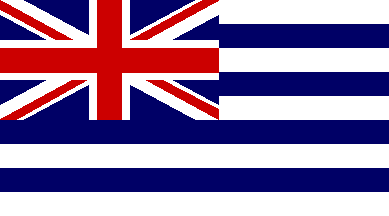
In an attempt to resolve this and other issues relating to British interests in New Zealand and acting on the instructions of the Colonial Office in London, Richard Bourke, governor of New South Wales, appointed a British representative, James Busby, whom he despatched to Waitangi in May 1833. Among Busby's tasks was a resolution of the flag issue. The British proposed three possible designs developed by the Admiralty (the agency of state controlling flags) in collaboration with the College of Arms (the branch of the royal household responsible for heraldic matters) in London. They included a striking flag reminiscent of not only the British East India Company and the revolutionary American Grand Union flags but also, more romantically, that of the Kingdom of Hawai'i and of newly independent Greece (adopted in 1822); it comprised four horizontal white bars on a blue field with a union jack  in the canton.

One of three British proposals for a New Zealand ensign (1835).
 António Martins, Flags of the World
In 1835 Busby submitted the three proposals to a selection of North Island rangatira who following a brief consultation selected the flag promoted by members of the Church Missionary Society (CMS), since 1814 the dominant Pākehā presence in the country <W Yate, An account of New Zealand and the formation and progress of the Church Missionary Society's mission in the northern island (London: Seeley and Burnside, 1835), p. 29>. The rapid process of choosing the flag was recorded by the CMS carpenter and catechist Henry Miles Pilley:
We had a grand day on Thursday, March 13. A man-of-war ship came in, bringing three flags with her, for the chiefs to decide by vote which should be the standard of the nation, as New Zealand was about to be placed on the scale of nations. Mr Bushy (sic), the British resident, provided a splendid dinner for the Europeans, which were from fifty to sixty in number, chiefly consisting of the captains and other officers of the man-of-war, captains of merchant ships, the missionaries and respectable settlers; the natives were also provided with plenty of boiled flour, which they esteem the greatest luxury. When the flag was hoisted, twenty-one guns from the man-of-war were fired, the natives joining in one continual shout of acclamations. The day was an important one.<H Pilley, The New Zealand missionary (Cheltenham: William Wight, 1838), p. 27>.
The selected flag comprised the St George's cross of England with the arms of the soon-to-be-established Anglican diocese of Australia in the canton. The ensign is known today as He Whataputanga or the flag of the United Tribes of New Zealand. While the missionaries were undoubtedly delighted by the choice of a flag invested with Anglican symbolism, the rangatira were more probably persuaded by the CMS-promoted flag having a higher proportion of red than the other two options. Moreover it wasn't so brazenly deferential to Britain. The decision on the flag foreshadowed the declaration of the independence of New Zealand made by a loose confederation of the same rangatira some months later.
The standard of New Zealand from William Yate,  An account of New Zealand and the formation and progress of the Church Missionary Society's mission in the northern island (London: Seeley and Burnside, 1835), p. 22. The flag of the United Tribes of New Zealand was perceived by the society's local representatives as a clear expression of Māori embrace of Christian symbolism. 
University of California
Busby's effort in resolving the flag issue was conveyed to the Colonial Office and in August 1835, having passed the final imprimatur of the Admiralty, the agreed ensign was officially gazetted making it possible for New Zealand ships to trade with British possessions, including not only Australia but also India. By flagging its own ships New Zealand made the first move into being a trading country, rather than one that just loaded its raw materials onto foreign vessels for others to process and sell. Adopting a flag asserted a level of economic as well as political independence but the process of 'selection' also confirmed New Zealand's entanglement in the amorphous web of the expanding British empire.
***
In February 1840, following the signing of the Treaty of Waitangi between Māori and a representative of the British crown, the flag of the United Tribes of New Zealand was supplanted by the various flags of the United Kingdom, primarily the British civil ensign, the union jack. Throughout the British empire flags were not only important symbols of power but also had significant functional purposes. The harbours in both Sydney and Auckland, amongst other colonial outposts, were marked by a series of manned flagstaffs which not only identified British hegemony but in the absence of alternative and reliable lines of communication also provided their administrators with a primitive form of radar. News of an arriving vessel up to around 50kms away could be signalled to colonial authorities in a matter of minutes, allowing them to not only determine the intent of the arriving vessel but also to enable their response. Until 1876, when New Zealand was connected by telegraph cable to the rest of the world, flags not only announced the arrival of orders, information and migrants but also, in the form of the union jack, reinforced a sense of British hegemony over the country and its sea lanes. 
After P Walsh The old Colours of the 58th Regiment, at present hanging in the Supreme Court, Auckland. The 58th (Rutlandshire) Regiment of Foot was sent to New Zealand in 1845 and remained there until 1858. The regimental colours were presented to the people of New Zealand in 1860. Reproduced in Auckland Weekly News (28 December 1900).
Sir George Grey Special Collections, Auckland Libraries (AWNS-19001228-6-4)
In a subtly different way, flags – ngā haki or ngā kara – became rallying points for Māori as they were progressively stripped of their lands by an expanding inflow of Pākehā settlers. Between 1844 and 1845, Hōne Heke, a Ngāpuhi rangatira, ordered the cutting down of the British flagpole at Kororāreka four times; the final felling saw British troops involved in fighting with and against various northern iwi. Flags were key elements on both sides of the Great New Zealand War as North Island Māori sought to protect their land from the predatory grasp of Pākehā capitalism between 1860 and 1872.
P Reveirs, [Māori rebel flag] No. 5, [c. 1865]. A watercolour rendering  of the flag of Te Kooti Arikirangi Te Turuki (c 1832-93), a Māori rebel leader and prophet from Ngati Maru, a hapu (subtribe) of the Rongowhakaata (tribal group). Judith Binney asserts the crescent symbolised a new beginning; the cross stood for the fighting Archangel Gabriel; and 'Wi' was a recurring holy day.
Museum of New Zealand Te Papa Tongarewa (1992-0035-1631-12A)
Whereas Pākehā flags deployed in the conflict were coded by tradition to conform with military and civil regulations, Māori approached the design of flags in a way that was both innovative and creative, drawing upon an appropriated lexicon of re-interpreted symbols and words to develop a new vexillogical vocabulary. But it was the rigid rules of the British Admiralty that devised the flag that for the twentieth century was used by New Zealanders to mark their land and identify themselves. 
Modern rendering of the flag deployed by Tauranga Māori fighting British troops at Pukehinahina (Gate Pā) in 1864. The flag was deployed strategically in the battle to mislead attacking British troops.
Tauranga City Libraries 
New Zealand's modest blue ensign devolved from the British blue ensign. Until 1864, when the Royal Navy was reorganised, the blue ensign was the flag of its Blue Squadron. Following reform, it was allocated to those ships either in government service or commanded by a reservist officer. In 1865 a regulation was promulgated requiring ships under the control of colonial governments to fly a blue ensign defaced by the badge or coat of arms of the appropriate colony. As the colony had no badge, let alone a coat of arms, the governor, George Gray, ordered that the flag be defaced with the letters NZ in red fimbriated in white. Merchant vessels registered in New Zealand were to fly a red ensign, defaced with the letters NZ in white. Lettering on flags was a relatively recent phenomenon that in the mid-nineteenth century was still associated in British official thinking with the American revolution. The lettered badge defacing the blue ensign was replaced in 1869 by four red five-pointed stars – representing the Southern Cross constellation – on either a white ground, or with the stars fimbriated in white, on a blue ground. While the union jack remained the national flag, the locally inflected blue ensign became used increasingly to identify New Zealand as a distinct political identity. Notwithstanding Admiralty objections, this situation became regularised in 1902 when the monarch approved the New Zealand Ensign Act, 1901 which established the defaced blue ensign as a distinctive flag for New Zealand. While not an inspired example of design, it's now the fifteenth oldest national ensign currently flying in the world.
F J Grant, Māori reception during the tour of the Prince of Wales, Arawa Park, Rotorua (1920).
Alexander Turnbull Library (PA Coll-7081-03)
The blue ensign, the symbol of the settlers, did not find much popularity amongst Māori who, if accepting of Pākehā hegemony, flew a red ensign defaced with their iwi name. Others, over the course of the twentieth century, either continued to fly the flag of the United Tribes of New Zealand or developed their own flags, drawing upon a variety of symbols and meanings. The Kīngitanga, for example, used a variety of flags and very early on regularised their use, effectively developing a tradition of reign flags. The current king Tuheitia's flag, which bears Te Paki o Matariki, the coat of arms of the Kīngitanga, was first raised in 2009. Other Māori independence movements, such as Kotahitanga, also deployed flags as 'symbols of mana and to show allegiances'. It was not until 1990 that a single flag representing Māori was proposed. It followed from two decades of activism as Māori sought to reclaim that which they had been denuded of by Pākehā.
Hiraina Marsden, Jan Smith and Linda Munn, Tino Rangatiratanga flag (1990).
James Dignan and António Martins, Flags of the World
Designed by Hiraina Marsden, Jan Smith and Linda Munn, the Tino Rangatiratanga flag – the name translates loosely as 'absolute sovereignty' –  was the winner of a nationwide competition to find a flag that represents all Māori. Although it employs traditional colours and references traditional symbolism, the flag's design – based on a magnification of  traditional kowhaiwhai (rafter decoration) – is very much of its time. As a consequence of coalition negotiations between the National party and the Māori party, the flag was accorded official status  as the national Māori flag in December 2009.

Changing the flag


Key's proposed referendum on changing the New Zealand flag is a step toward realising an ambition long held by a number of New Zealanders to replace the current blue ensign with a flag that symbolises how they feel about their country. There have been numerous proposals over the years. Most of these have tended to be vexillogical nightmares: bizarre conflations of colours, overly literal symbolsvisionary chimeras and, somewhat embarrassingly, a new phase of Pākehā appropriation of Māori iconography, albeit at a remove. Announcing his decision to hold a referendum, Key indicated that his flag of preference was a white 'silver fern' leaf on a black field, not coincidentally, an image most commonly associated with the All Blacks, the New Zealand national rugby football union team.
Dave Clark, Silver fern design for the New Zealand Rugby Football Union (1991). One of many proposal for a black flag defaced with silver fern frond. Some versions place the words 'New Zealand' underneath the frond.
Wikimedia
The first official use of the fern as a symbol of New Zealand seems to have occurred in 1869 when the British War Office issued a campaign medal to British and colonial servicemen and Kūpapa involved in fighting those Māori resisting settler incursion in Taranaki and Waikato during the New Zealand Land Wars of 1860-1866. The fern pattern did not appear on the medal itself – the reserve was designed with a conventional victory laurel wreath – but on the arms of the ribbon suspender. Under the circumstances it might be considered somewhat ironic that a fern – the first symbol used to identify the country by its colonising power – has been appropriated by those ostensibly seeking to remove the symbols of the country's 'colonial and post-colonial era'.
Unidentified designer for the British War Office, New Zealand medal (1869).
New Zealand Defence Force Te Ope Kātua o Aotearoa
The silver fern first entered the New Zealand state's iconography when it was paired with an oak branch to form a wreath on the obverse of the New Zealand Long and Efficient Service Medal which was first issued in 1887 to veterans with sixteen years service in the New Zealand Militia. The medal was probably designed by its first manufacturer, the Prussian-born Wellington-based goldsmith and jeweller Siegfried Kohn. Kohn had earlier designed the medal awarded at the New Zealand Industrial Exhibition (Wellington, 1885) which also depicted fern fronds, albeit those of the button fern, rather than the silver fern (Pellaea rotundifolia in preference to Cyathea dealbata). 
Siegfried Kohn (1854-19?), New Zealand Industrial Exhibition silver medal (1885).
National Museum of New Zealand/Te Papa Tongarewa, bequest of Mrs Mary H Quin, 1956 (PC000254)
A later military medal, the New Zealand Volunteer Service Medal of 1902 depicted a full wreath of silver fern fronds on its reverse. The military application of these depictions suggest not only that the fern wreath was seen as a local inflection of the laurel wreath given to the victorious in antiquity, but it also ties in with the nascent nationalism evident in the colony from the 1880s.
Siegfried Kohn (1854-19?), New Zealand Long and Efficient Service Medal (1887).
National Museum of New Zealand Te Papa Tongarewa, gift of Mr Dollimore, 1956 (NU006152)
By the time of the Second World War the silver fern had acquired significant military associations, being used in the design of military cap badges, ship's badges of the newly formed Royal New Zealand Navy and a range of other naval, military and police applications. Its medallic apotheosis came with the New Zealand War Service Medal, designed by the academic John Cawte Beaglehole and the artist Mervyn Taylor in 1947. Beaglehole recounted that the Labour 'Cabinet says it doesn't like the Army's idea, what Cabinet wants is a fern-leaf like on the All Black's jersey, & Peter [Fraser, the prime minister] asks me to arrange it accordingly.' <Letter from J C Beaglehole to Janet Paul, 10 July 1947, cited in T Beaglehole, A life of J C Beaglehole (Wellington: VUP, 2006), p. 300>.
John Cawte Beaglehole (1901-1971) and Mervyn Taylor (1906-1964),  Reverse of the New Zealand War Service Medal, [1947].
New Zealand Defence Force Te Ope Kātua o Aotearoa
The national rugby football union team, the All Blacks, adopted the silver fern frond on a black ground logo in 1893, six years after its appearance on the Long and Efficient Service Medal. While rugby union football might well be regarded as 'the national game' by its supporters, it is, like the military, an activity that's largely the preserve of young males, with an emphasis on disciplined physicality. Unsurprisingly, the military's symbols leached, probably quite subliminally, into those of sporting teams, and vice versa. 
E Kelley, All Black rugby team that toured the United Kingdom in 1905-6
Making New Zealand: negatives and prints from the Making New Zealand Centennial collection.
Alexander Turnbull Library (MNZ-1035-1/4F)
Both the New Zealand military and the New Zealand Rugby Football Union (NZRFU) are fundamentally conservative organisations and the innocuous, if somewhat laudatory, quality of the fern leaf emblem, one untarnished by history and devoid of any significant pre-association, would have appealed to the mindset of those responsible for choosing its differentiating emblems. In recent years, as the game of rugby has lost its amateur status, the All Black livery has been turned by the NZRFU (now known as Rugby New Zealand) into a legally-protected corporate logo. However, although a version of the silver fern was trademarked in 1991, the increasingly corporatised NZRFU's attempts to control the image have foundered in litigation with the assistant commissioner of trademarks ruling in 2008 that the silver fern was 'very broad in scope and had a low level of inherent distinctiveness'.
Crispin Schuberth, New Zealand Labour party logo (2011)
Although its most prominent incorporation into the regalia of state came about through the wishes of a Labour party cabinet and that it has intermittently formed a part of the New Zealand Labour party logo, the silver fern has, since the 1970s, been favoured by National party and corporate interests as a suitable symbol for replacing the current New Zealand flag. In 1998 the National party minister of cultural affairs, Marie Hasler, supported by the then prime minister Jenny Shipley, argued that the current blue ensign should be replaced by the silver fern on a black ground, claiming that 'our most constant and enduring symbol is the Silver Fern. It is the most commonly used and instantly recognisable New Zealand symbol'. This assertion has been promoted by a number of corporate interests, most notably the late Lloyd Morrison, CEO of the investment group Infratil, who established a charitable trust NZflag.com to promote both a change in the New Zealand flag and the adoption of a silver fern flag design. While the silver fern on a black ground flag might seem distinctive from the point of view of those more familiar with rugby, the army and corporate logos it is far from distinctive, as the recent tragic events in Sydney and the rise of the Islamic State in the Middle East attest. 
Islamic black standard defaced with the Shahada.
Wikimedia
Embracing a somewhat pedestrian corporate logo as 'the symbol of the Realm, Government and people of New Zealand' not only denies the history of the flags that have been flown in this country but also condones a narrow understanding of how flags best represent a nation. Sovereign nations shouldn't be represented by symbols and colours that reflect particular interests, no matter how popular they might seem. 
Unidentified designer for the New Zealand Transport Agency, silver fern roads logo for a  New Zealand government road safety campaign (2014)
saferjourneys.govt.nz
Flags are emotional things. In a recent essay on the way the English St George's cross flag has come to be seen as projecting a racist and bigoted perception of the world, often associated with football hooligans and white van-driving, working class males (the two are not exclusive), the Guardian columnist, Stuart Jeffries noted that 'Flag waving is a veil, hiding precisely nationalism's desire for power and the flag waver's desire to exclude and subjugate the other.' It's a sentiment New Zealanders might consider as they contemplate how they're next going to wave their flag not only amongst themselves but also to the world. Rebranding sometimes goes horribly wrong.


Postscript


Key has changed his view on the design of a possible flag, sort of.