Showing posts with label Danish design. Show all posts

Wednesday, 22 October 2014

The joy of Danish design

Notwithstanding the fact that Danish design appears to be a current favourite of at least one New Zealand auction house (it forms a significant component of Art + Object's Nordic design sale on 22 October 2014), in the unlikely event that New Zealanders give much thought to the history of the subject, it’s most probable they’ll opine it emerged, fully formed, with the architect Arne Jacobsen’s well-known Myren stol (Ant chair) in 1951. There may be some slight awareness of earlier design endeavours including, possibly, a conflation of Scandinavian design (Denmark, Norway and Sweden) with Finnish design and a vague recollection of the work of the influential modernist Finnish architect Alvar Aalto (1898-1976). In terms of accuracy, this is probably on a par with believing that New Zealand comprises the pristine, clean, green paradise of the Saatchi and Saatchi ‘100% Pure’ advertising campaign for Tourism New Zealand, rather than the deeply compromised colonial landscape of pest plants and animals, factory farming, industrial forestry and motorways that it has become. It's always difficult to correct ill-informed myths.

Outsider views of the development of Danish design have tended to reflect its marketing as a thoroughly modern, contemporary, phenomenon. This stance is not entirely uncommon; most people tend not to think of the historical antecedents of the objects they commonly surround themselves with. In Denmark things are a little different thanks, in part to a long-standing educational programme about design that dates from the establishment of the Royal Danish Academy, Det Kongelige Danske Skildre-, Billedhugger- og Bygnings-Academie i Kiøbenhavn (now known generally as Kunstakademiet), in 1754. This programme of design pedagogy gained significant momentum following the striking success of Den Nordiske Industri-, Landbrugs- og Kunstudstilling, the Nordic industrial, agricultural and art exhibition, which was held in Copenhagen in 1888. In the aftermath of the exhibition and inspired by the activities of the Paris-based Union des Arts Décoratifs, a collaboration between Danish industrialists, artists and historians sponsored the establishment in 1890 of a museum of Danish design, Det Danske Kunstindustrimuseum (known, more colloquially, as Kunstindustrimuseet). Since 2011, the museum has been known by the gimmicky neologism Designmuseum Danmark.

Originally located near the Tivoli pleasure gardens, the museum moved in 1926 into the restrained rococo premises of the former kongelige Frederiks hospital (Nicolai Eigtved/Laurids de Thurah, 1752-57) on Bredgade (the hospital is best known to history as the place where Søren Kierkegaard died in 1855), near Eigtved’s equally delightful and better-known Amalienborg palace (1750). The conversion of an eighteenth century hospital into a twentieth century museum of design was undertaken by the furniture designer Kaare Klint (1888-1954) and the architect Ivar Bentsen(1876-1943). The integrity of their redesign of the hospital space remained intact until recently suggesting not only the simplicity of their re-arrangement of the space and its flexibility but also the enduring quality of their design.
A remnant display of late nineteenth century Danish design in the galleries developed by Kaare Klint and Ivar Bentsen in Kunstindustrimuseet. The glass cases along the right wall were also designed by Klint
The museum’s collection reflects both the extraordinary creativity of Danish designers and makers over the past two and a half centuries as well as the scholarship and research interests of not only its curatorial staff but also that of major donors to the collection over the past 125 years such as Hugo Halberstadt whose collection of Japanese arms and armour – given to the museum in 1941 – was, in the estimation of Nobuo Ogasawara of the National Museum of Japan, ‘one of the finest collections of its kind anywhere in the world’. The museum’s collection of Asian and European ceramics, while relatively small when compared with those of, say the Victoria and Albert Museum in London, is encyclopedic and of a notably high quality. Moreover, the museum has one of the most comprehensive (and delightful) libraries of decorative arts and design to be found anywhere in the world.
Twentieth century furniture displays dating from the early 2000s located within the intact Klint and Bentsen galleries
However, along with its change of name, the museum seems to have decided that Danish design is best represented by exhibitions of modern Danish furniture and its current displays reflect this partial belief. Alongside a long-installed gallery of twentieth century Danish furniture, the museum is currently showing three temporary furniture exhibitions: Øvelse gør mester: Kaare Klints møbelskole (Practice makes perfect: Kaare Klint’s furniture school), which focuses on Klint's pedagogical activities; Møbler til folket! Børge Mogensen 100 år (Furniture for the people! Børge Mogensen’s centenary); and Wegner: bare een god stol/just one good chair, a comprehensive exhibition devoted to the work of Hans Wegner (1914-2007) curated by Christian Holmsted Olesen.
The Wegner exhibition, which runs until December 2014 and comprises some 132 objects, is the most scholarly and the best displayed of the three temporary exhibitions. The exhibition is complemented by a meticulously researched and illustrated catalogue that, conveniently, is available in an English language version. The Klint exhibition (on display until February 2015) is undermined by an obscure take on the subject, intrusive exhibition design and a touching belief in the effectiveness of electronic gadgetry. The Møgensen exhibition is comprehensively overwhelmed by the others.
Unidentified photographer, John Fitzgerald Kennedy, president of the United States of America, seated in Hans Wegner's 1949 designed 'Den runde stol (The round chair)' in 1960. The chair was manufactured in oak by Johannes Hansen Møbelsnedkeri.
Designmuseum Danmark
From a marketing perspective Wegner was the archetypal post-war Danish designer. Aside from his sheer productivity, the popularity of his designs in the United States, particularly during the 1950s and 60s, prompted a massive expansion in the export of Danish furniture around the world. The notable exception to this trend was in New Zealand and Australia where protectionist tariffs and import licensing regimes made its acquisition financially unfeasible for most consumers. Would-be Antipodean consumers of modernist furniture in the 1950s and 60s had to put up with what, more often than not, were shabbily-produced, pirated travesties of the Danish originals. Contemporary Antipodean consumers of modernist Danish furniture might be well-advised to visit the exhibition before indulging their tastes. If that proves impossible, then the acquisition of Olesen's impressive book would be an adequate, if less tangible, substitute. 

It's unfortunate that in pursuit of it's recently announced strategy 'of pursuing alternative exhibition and communication approaches' and re-jigging itself as a 'central exhibition venue', Designmuseum Danmark has decided to move its public focus from a collection that provided it with a unique identity and fostered a remarkable, scholarly, research culture. The museum's pursuit of the chimera of public relevance is hardly unique  – witness the sad spectacle of the V&A's social media-driven 'rapid response collecting strategy' – but it's depressing to see it being embraced with such unreflective abandon. 

Sunday, 30 June 2013

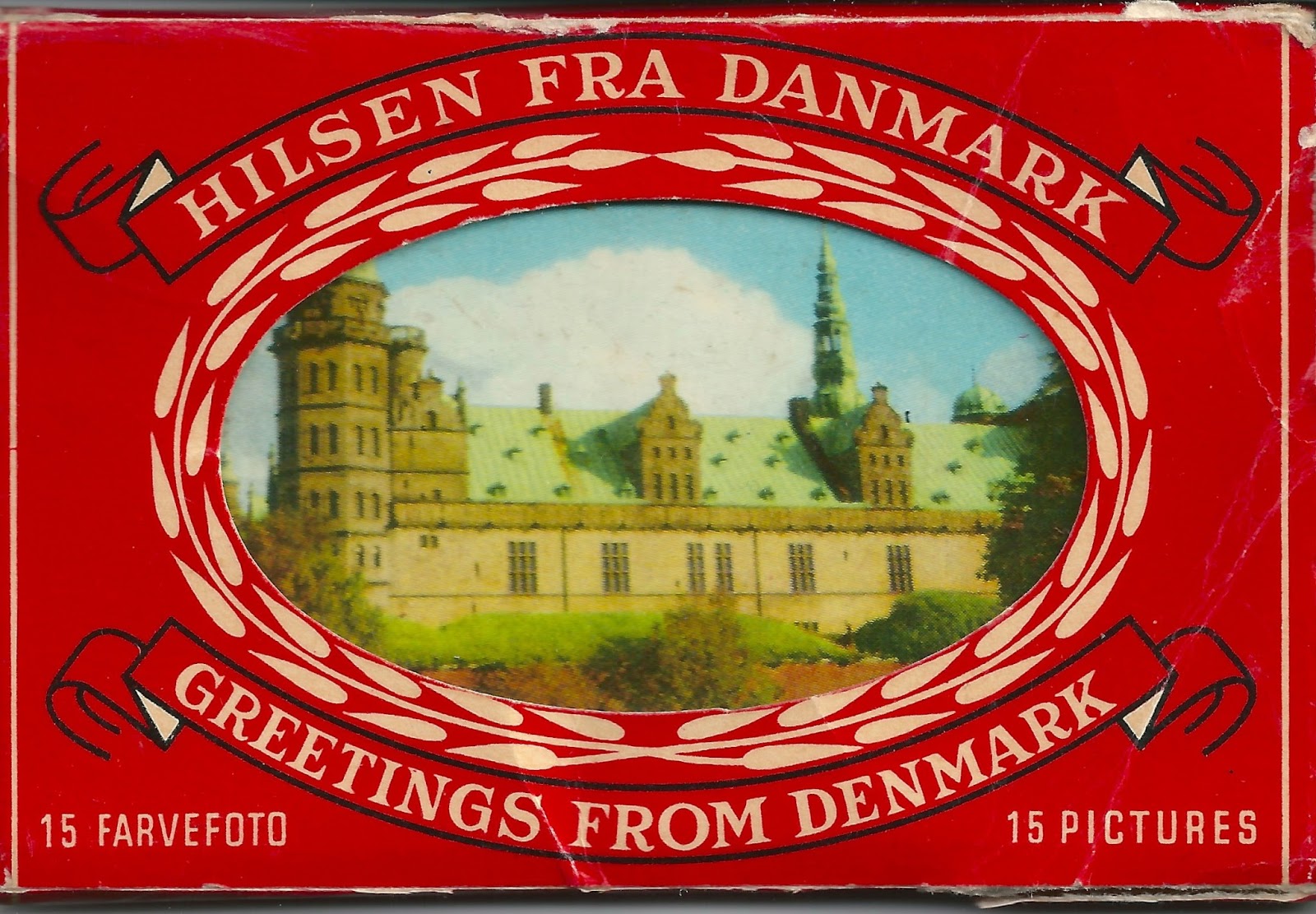
Hilsen fra Danmark/Greetings from Denmark


Souvenir cards from Denmark, 1960. The image
shown depicts Frederiksborg Slot in Hillerød

The Auckland auction house Art+Object is currently promoting its forthcoming modern design auction. The sale – to be held on 4 July 2013 – includes a selection of Scandinavian-designed furniture, including chairs by Hans Wegner, Børge Mogensen, Orla Mølgaard-Nielsen and Peter Hvidt and a FA 66 sideboard (lot 463) designed by Ib Kofod-Larsen (mistakenly identified in the catalogue as Kofed Larsen) for Faarup Møbelfabrik I/S (not identified in the catalogue). It’s all good quality stuff, although you regret the absence of any reference to provenance in the lot descriptions: were these pieces imported into New Zealand contemporaneously; or do they have a more recent acquaintance with the country; were they a manifestation of New Zealand's earlier fascination with Scandinavia, or a more recent iteration of that phenomenon?

New Zealand House, Haymarket, London
seen from Trafalgar Square
In the period following the second world war, the export success of Scandinavian design was the envy of manufacturing interests around the world. Even in New Zealand, Scandinavian design garnered recognition, sometimes from the most unlikely of quarters. In an effort to add a sophisticated gloss to the soon to be completed New Zealand House (Robert Matthew, Johnson Marshall & Partners, 1963) in London, the New Zealand government specified Scandinavian-designed objects for its fit out. Writing about the building in 2005, Harriet Atkinson records that: ‘Furniture, crockery and glass were part of the architect’s planning, the majority bought from Scandinavian manufactures. The furniture was designed by Kjærholm, Ekselius, Wegner, Matheson and Finn Juhl; the crockery by Rörstrand; and the glass by Orrefors.’ Sadly, none of this cornucopia of designed objects remains in the parts of the building still occupied by the New Zealand High Commission in London.

One of the earliest New Zealand references to Scandinavian design occurred in the New Zealand Design Review in its October-November 1952 issue. Beatrice Ashton (1920-1999), a regular contributor on design matters, recalled a rumour she had heard that ‘a Swedish craftsman was working in wood in Havelock North.’ Commenting that it ‘seemed an unlikely idea and an unlikely place to find such a man’, she visited him: ‘Right in the centre of Havelock North we found an enchanting shop. We felt suddenly that we were in San Francisco again (she'd passed through California in February 1944) except that the goods in the window were unmistakeably Swedish.’
The interior of Karl Axel de Flon's Swedish design shop in 
Havelock North, 1952. New Zealand Design Review vol. 4, no. 5 
(October-November 1952). Photographed by John Ashton


The shop stocked a range of Swedish crafted wood, ceramic and textile items and had been established by Swedish furniture designer Karl Axel de Flon who recounted he had ‘met a furniture manufacturer from Hawkes Bay in Auckland when I first arrived and he asked me to be his designer. But it didn’t work out. No one here bothers to carry out designs carefully, so I opened my shop instead.’
De Flon’s enterprise failed when, in 1952, a new licensing schedule introduced by the New Zealand Board of Trade ‘had dried up his supply of Swedish glass and pottery’; the schedules were allocated in part on the basis of an applicant’s import history; de Flon had no such history and he appears to have closed the shop and returned to Sweden. 
Covered bowl from the Blå Eld (Blue Fire) range, 
designed by Hertha Bengston for Rörstrand in 1950, 
retailed in Auckland by Patrick Pierce
More experienced retailers such as Dan Pierce, who sold ceramics and glass as Patrick Pierce in central Auckland and suburban Takapuna, did have a history and managed to circumvent import restrictions favouring British suppliers and was selling Rörstrand ceramics and Orrefors glass to discerning Aucklanders in the mid 1950s.

A more viable translation of Scandinavian design to New Zealand occurred in the mid 1950s when Ken and Bente Winter from Århus in Denmark set up as manufacturers of economically-priced furniture in Auckland, eventually opening a retail outlet in Symonds Street in 1962. Two years later they launched the brand ‘Danske Møbler’ (Danish for Danish furniture) in 246 (Rigby Mullan, 1964), a multi-storey vertical shopping mall with up-market aspirations located at 246 Queen Street, Auckland’s main retail strip, that had been developed by the theatrical entrepreneur Robert Kerridge. While its current output gives no indication of its Danish origins – other than its name – the company still survives as a local manufacturer.

Interior view of the Smith-Sutch house designed by Ernst Plischke.
Unidentified photographer, published in the Architectural Review
October 1959
Probably the greatest advocate of Scandinavian design in New Zealand during the 1950s and early 1960s was Dr William Ball Sutch, an economist, historian, collector and a noted patron of good design; his house in Brooklyn was designed by Ernst Plischke (1953-56). But as assistant secretary in the Department of Industries and Commerce, Sutch’s concern with Scandinavian design wasn’t about aesthetics but rather about the way it could be seen as an exemplar for New Zealand as it sought to maintain its then enviable material living standards. In a wide ranging speech delivered to the January 1957 Dunedin conference of the Australian and New Zealand Association for the Advancement of Science, Sutch declared that:
As the country grows, New Zealand’s main assets can only be the skill, experience and intelligence of her people Small countries like Finland, Denmark or Switzerland have even fewer natural resources than we have. Yet because of the skill of their people hey are important manufacturing countires […] New Zealand’s preoccupation with the tariff may be too negative an approach. Should we not be concerned with producing goods which have as their main ingredient not raw materials but brains and skills. (W B Sutch, The next two decades of manufacturing in New Zealand, 1957, p. 21)
Sutch’s pleas fell, for the moment, on deaf ears: the National party government was panicking to ensure that in the face of Britain’s effective abandonment of its economic empire ‘there were secure and remunerative outlets for the nation’s agricultural surplus.’

The re-election of a Labour administration in November 1957 gave Sutch, who was shortly after appointed secretary of the Department of Industries and Commerce, an opportunity to pursue his interest in seeing how Scandinavian we could be. Soon after his elevation Sutch established a design study group within the department charged with researching the possibility of establishing a design promotion body, that he anticipated would be loosely modelled either on the British Council of Industrial Design or the recently established Industrial Design Council of Australia. Following the study group’s work, Sutch realised that neither the British nor the Australian templates were appropriate to the New Zealand situation and turned to Denmark for inspiration. Writing in 1963 to the departing Danish chargé d’affaires, Thorkild Wegener-Clausen, Sutch opined that ‘Denmark  must be one of the examples which New Zealand must follow if it is to develop as a mature nation with a continuing good living standard.’ In practical terms, Sutch concluded that the model offered by Den Permanente, a retailing display centre of Danish craft and design in Copenhagen, would be the best way of encouraging and promoting design in New Zealand.


Two wooden mice, designed by Theodore Skjøde Knudsen, made by Skjøde Skern I/S,
retailed by Den Permanente and bought by an Auckland tourist in Copenhagen in August 1961

Formed in 1931 by the Landsforeningen Dansk Kunsthåndværk (the Danish Society of Craft), Den Permanente ‘was an association, not a business. The exhibitors were members who elected the board […] It arranged special exhibitions, and during the 1950s and the beginning of the 1960s Den Permanente became well known as far away as Japan and the US. Approximately 75 per cent of the sales went abroad, primarily to the US’ (Per H Hansen, The construction of a brand: the case of Danish design, 1930-1970). Sutch speculatively felt that this combination of craft and industrial production was more appropriately suited to the situation prevailing in New Zealand. This contention was driven by the idea that the local recreation of something like Den Permanente might start making New Zealand producers and consumers more conscious of design.

Sadly, it was not to be. The National party administration elected in November 1960 forced Sutch into retirement in March 1963 - his politics were deemed to be too radical and the minister, John Marshall, loathed and feared him. The design promotion body that eventually emerged in 1966, The New Zealand Industrial Design Council, was an anaemic replica of the British model. Despite early successes under its first director, Geoffrey Nees, it was invariably under-resourced and its existence was always under threat. It was abolished in 1988; never was Scandinavia so distant from New Zealand. It would take the Nokia success story of the 1990s for New Zealand to start, hopelessly and unthinkingly, aspiring once again to be the Scandinavia of the south.